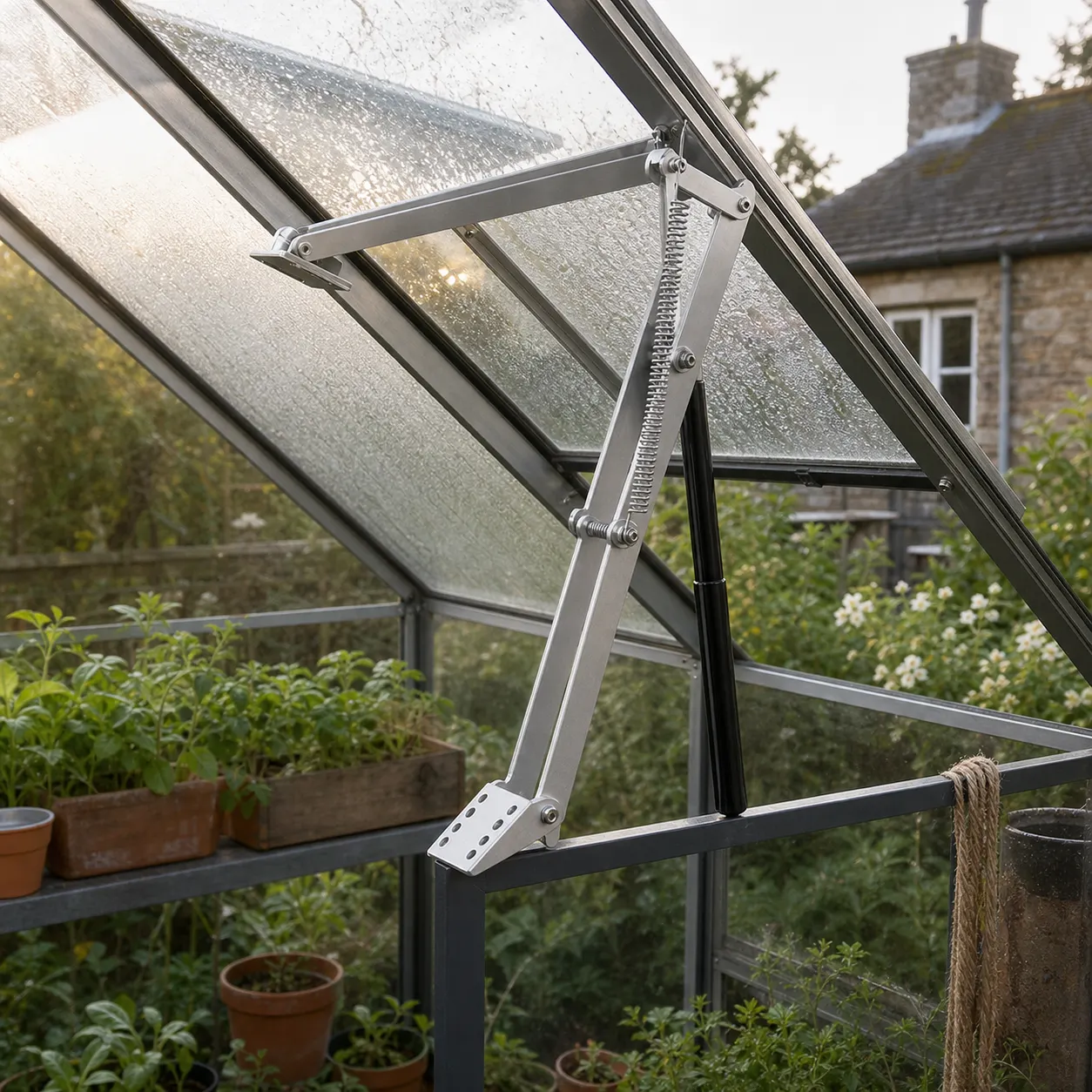
Short answer: An automatic greenhouse vent opener is worth comparing when a roof window needs to respond to warmth while you are away, but the vent must fit first. The current listing describes a thermally activated greenhouse window opener with all-aluminium dual-spring construction and a 7 kg or 15 lb load rating. It does not specify activation temperature, opening angle, universal greenhouse compatibility, wind resistance, certification or service life. Check that your opening is a freely moving roof window, assess its load and fixing points, then test the mechanism before leaving valuable plants to rely on it.
What the vent opener listing confirms
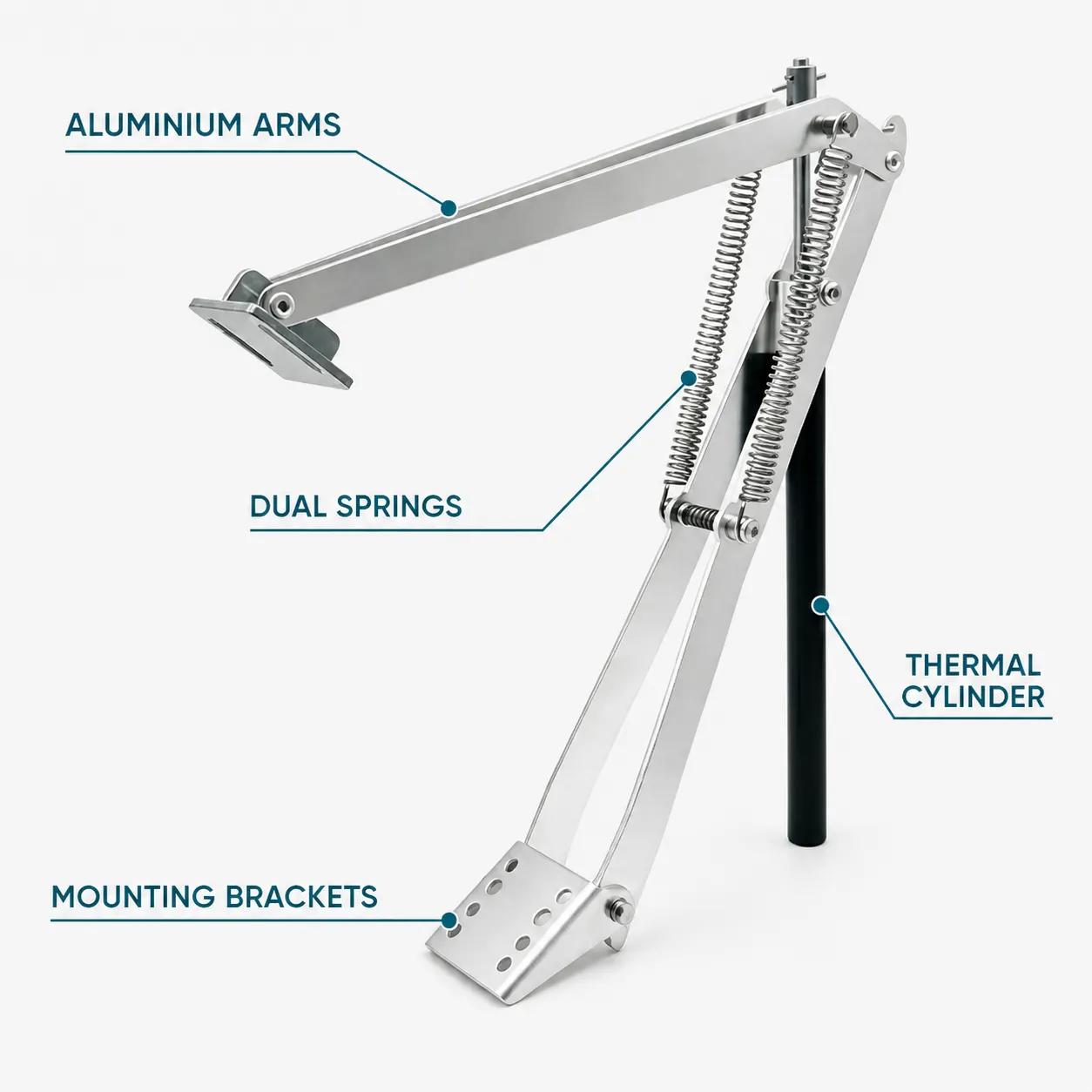
The product page identifies a thermally activated greenhouse window opener with all-aluminium dual-spring construction and a 7 kg or 15 lb load rating. Those facts are enough to place it in a passive roof-vent shortlist. They do not establish that it fits every greenhouse frame or every style of opening.
The manufacturer does not specify activation temperature, opening angle, bracket dimensions, fixing pattern, vent compatibility, wind resistance, corrosion performance, certification or service life. A product photograph cannot replace those missing measurements.
| Check | Published position | Before ordering |
|---|---|---|
| Operating idea | Thermally activated window opener | Confirm the opening is a suitable roof window |
| Construction | All-aluminium dual-spring | Do not infer service life or corrosion performance |
| Load | 7 kg or 15 lb listed | Assess the actual window and movement |
| Timing and travel | Manufacturer does not specify | Ask about activation temperature and opening angle |
Match the mechanism to the greenhouse
Start with the moving part. A hinged roof vent is a different installation from a side louvre, sliding panel or greenhouse door. Open the window by hand through its normal travel. It should not scrape, twist, jam or depend on a bent manual stay, because an opener cannot repair a distorted frame.
Compare the panel and fixing area with the listed 7 kg or 15 lb rating. Do not estimate suitability from greenhouse size alone: a small glass panel may be heavier than a larger lightweight one, and a stiff hinge adds resistance. The manufacturer does not specify a universal frame or brand fit.
- Identify the opening as a hinged roof window, louvre, door or another type.
- Move it by hand and correct sticking, dirt or misalignment first.
- Assess the window load against the listed 7 kg or 15 lb rating.
- Check that the frame and fixing points are sound.
- Confirm the bracket and installation method before drilling or fitting.
Test ventilation as part of the growing routine
A thermal opener can reduce the need to remember one roof-vent movement, but it is not a complete greenhouse climate system. A hot spell may still require doors, other vents, shade, watering or a change in plant spacing. The product page does not state that one opener controls a whole greenhouse or protects crops in every weather condition.
After fitting, observe the window through warmer and cooler periods before relying on it unattended. Check that it opens and closes without binding and that the vent is secure when the weather changes. If the crop depends on a specific opening temperature or angle, the manufacturer does not specify those values, so plan additional monitoring.
Limits and installation boundary
Choose this product for a freely moving greenhouse window where the load and fixing arrangement are suitable. Do not treat the listing as proof of a particular greenhouse-brand compatibility, activation schedule, maximum wind condition, corrosion life, certification or long-term durability.
The manufacturer does not specify drilling instructions, opening angle, temperature thresholds, replacement parts or service life on the current page. If any of those details affects the safety of the frame or the health of valuable plants, obtain the missing information before installation or choose a better-documented mechanism.
Related guides and product details
Buy the opener only when the roof window moves freely, stays within the 7 kg or 15 lb rating and has a confirmed installation fit. Read Greenhouse Auto Vent with No Electricity: Check the Window for related guidance. Read Thermal Greenhouse Window Opener: A Practical Fit Check for related guidance. Review the documented specification on the Thermally Activated Greenhouse Window Opener product page before ordering.
Sources and safety context
- Supports the thermal operation, all-aluminium dual-spring construction and 7 kg or 15 lb load rating. Current greenhouse window opener page.